
ExoSett story
Almost Home
Margaret is ready to leave hospital, but her house is not yet somewhere she can safely return to. This story imagines how a National Accommodation Service could offer a nearby home while the adaptations are completed.
My house keys were in the drawer beside the hospital bed. Every morning, when I reached for my glasses, I heard them slide against the back.
I had been told I could leave hospital. I no longer needed treatment there. I could wash, dress and make myself something to eat, provided everything was on one level. For a little while, someone would call in each morning to help with the things I still found difficult.
At home, my bedroom and the only bathroom were upstairs.
I am seventy-six. I have lived in that house for thirty-two years. Until the fall, I had not thought much about how often I used the stairs.
The occupational therapist had looked at the house with my daughter, Ruth. A bed in the dining room would solve one problem, but it would not bring the bathroom downstairs. We had agreed on a stairlift and alterations to the bathroom. Getting the work arranged and finished would take several weeks.
Ruth’s flat had stairs too.
Everyone was trying to help. There was still nowhere suitable for me to go.
I wanted to open my own curtains in the morning. That had become quite important.
The discharge coordinator asked whether she could contact the National Accommodation Service, or NAS, about somewhere to live while the work was done.
“But I’ve got a house,” I said.
“Yes,” she said. “We’re looking for somewhere you can manage now.”
I asked whether accepting it meant I had agreed to move out of my house for good.
It did not. The arrangement would be reviewed if my circumstances changed, but the plan was for me to return once the alterations were finished and I could use the house safely.
Two days later, she showed me a home in an ExoSett building near the library. An accessible flat had recently been prepared for its next resident. It was available now.
I knew the building. My friend Jean passed it on her way to the shops.
Ruth went with me to look. There were no steps from the pavement to the front door. Inside, I could get between the bedroom, bathroom and kitchen without squeezing past furniture. I tried the shower seat and checked that I could reach the cupboards I would use.
The occupational therapist checked the things I would not have thought to try. We agreed where a couple of items should go before I moved in.
The flat came furnished. The accommodation and essential services were provided without charge; I would buy my own food and bring the things I wanted around me.
“Could I bring my reading lamp?” I asked.
“Of course.”
I chose the flat. My usual GP could remain my GP, and the morning visits were arranged for the new address. By Friday, everything was ready.
Ruth collected me from hospital. I thanked the people who had looked after me, checked the bedside drawer twice and put my keys in my handbag.
At the flat, the local NAS officer showed me the heating controls and left a number to call if anything in the home needed attention.
I nearly asked him what time supper came.
Instead, I asked Ruth to put the groceries on the table where I could reach them.
We had scrambled eggs on toast. I said the eggs needed another minute. Ruth said they were fine.
It was a familiar disagreement.
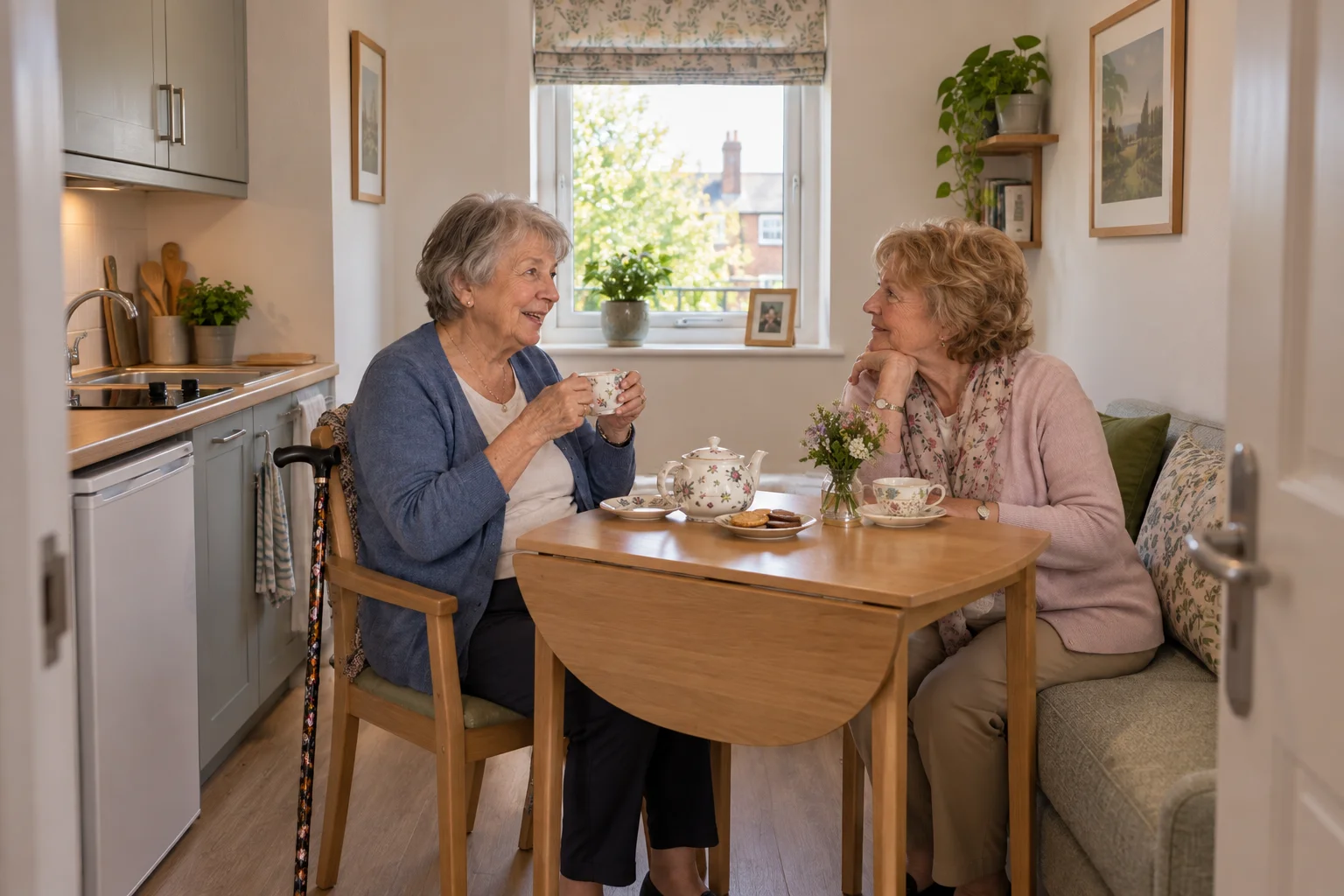
The first few mornings, a support worker called as arranged. She helped with the things we had agreed, then went on to her next visit. As I managed more, the support team reviewed the visits with me.
The rest of the day was mine.
I slept badly at first. The fridge made a different noise from the one at home, and I kept looking for the light switch on the wrong side of the bedroom door.
But I could get to the bathroom without standing at the foot of a staircase and wondering whether I ought to try.
Jean came on Tuesday. She brought biscuits and a bag of post from my neighbour.
She had allowed far too long for the journey and arrived while I was still in my dressing gown.
“You can put the kettle on,” I told her.
By the following week, we had settled on Thursday afternoons. Ruth still called after work, but she no longer spent every visit making telephone calls on my behalf. Sometimes we just watched television.
I missed my garden. My neighbour sent photographs, including one of weeds she appeared to think I would enjoy seeing.
Then the bathroom work was delayed. A fitting had not arrived, and the contractor needed another fortnight.
I rang the NAS contact, worried that I would have to leave the flat on the date we had first discussed.
She noted the revised timetable. We would agree the handover when the house was ready; I did not need to pack.
I was cross about the delay. Then I went back to deciding what to have for lunch.
Nine weeks after I left hospital, the work was complete. I went home with the occupational therapist to try the stairlift and the altered bathroom. There were a few things to explain, and a handle to adjust. We checked them before settling the moving date.
I had been looking forward to returning. I was surprised to find I would miss the flat.
On the last Thursday, Jean came as usual. Most of my things were packed, but I had kept the cups out.
The NAS team had arranged to inspect the home after I left and prepare it for whoever needed it next. I would leave the furniture and return my key. My reading lamp was coming with me.
At the house, Ruth put it back beside my armchair.
Through the window I could see that my neighbour had dealt with the weeds after all.
“Tea?” Ruth asked.
I told her to sit down. I knew where everything was.
This story illustrates how an ExoSett system might be used. Actual implementations would require project-specific engineering, detailed design and any necessary regulatory approval.
What this story illustrates
Having a home does not always mean having suitable accommodation. A change in mobility can create an immediate need that adaptations or a longer-term move will take time to resolve. The National Accommodation Service imagined here responds to that current need, including when someone already owns or rents a home.
A pool of accessible homes can provide buffer capacity between those different timescales. Margaret’s quick allocation depends on a suitable home already being available locally. Proximity to her friends, family, GP and visiting support is part of its suitability. Such a match depends on need and available capacity; it cannot be assumed in every location.
NAS provides Margaret with a home. Her discharge arrangements and any health or social-care support remain the responsibility of the relevant services, working with her. Suitable accommodation can resolve an accommodation barrier to leaving hospital; it cannot replace care that someone still needs. Solving her housing problem also allows an acute hospital bed to become available for another patient.
The stay is temporary, but the home must offer the comfort, privacy and accessibility expected of any dwelling. The allocation continues while Margaret needs it, with review as circumstances change and an agreed handover once her house is suitable. If returning were no longer possible, her continuing accommodation need would have to be addressed.
After she leaves, inspection and any necessary repairs or preparation return the home to the local accommodation pool. Another resident’s need may be quite different. Moving between homes need not involve moving the modules themselves.
ExoSett’s adaptable accommodation modules could help maintain and adjust that stock over time. Accommodation design must make each home suitable for its occupants, including its layout, access and relationship to the surrounding community.
For other NAS life transitions, see The First-Time Buyer. For decisions involving suitability and limited capacity, see The Resolver.