
ExoSett story
Hotels that evolve
Hotel demand changes over time: room mix, capacity, guest expectations and the services a property needs can all shift. ExoSett explores how an adaptable modular hotel could add, remove, replace or reconfigure accommodation as the market changes, without treating every change as a major rebuilding project.
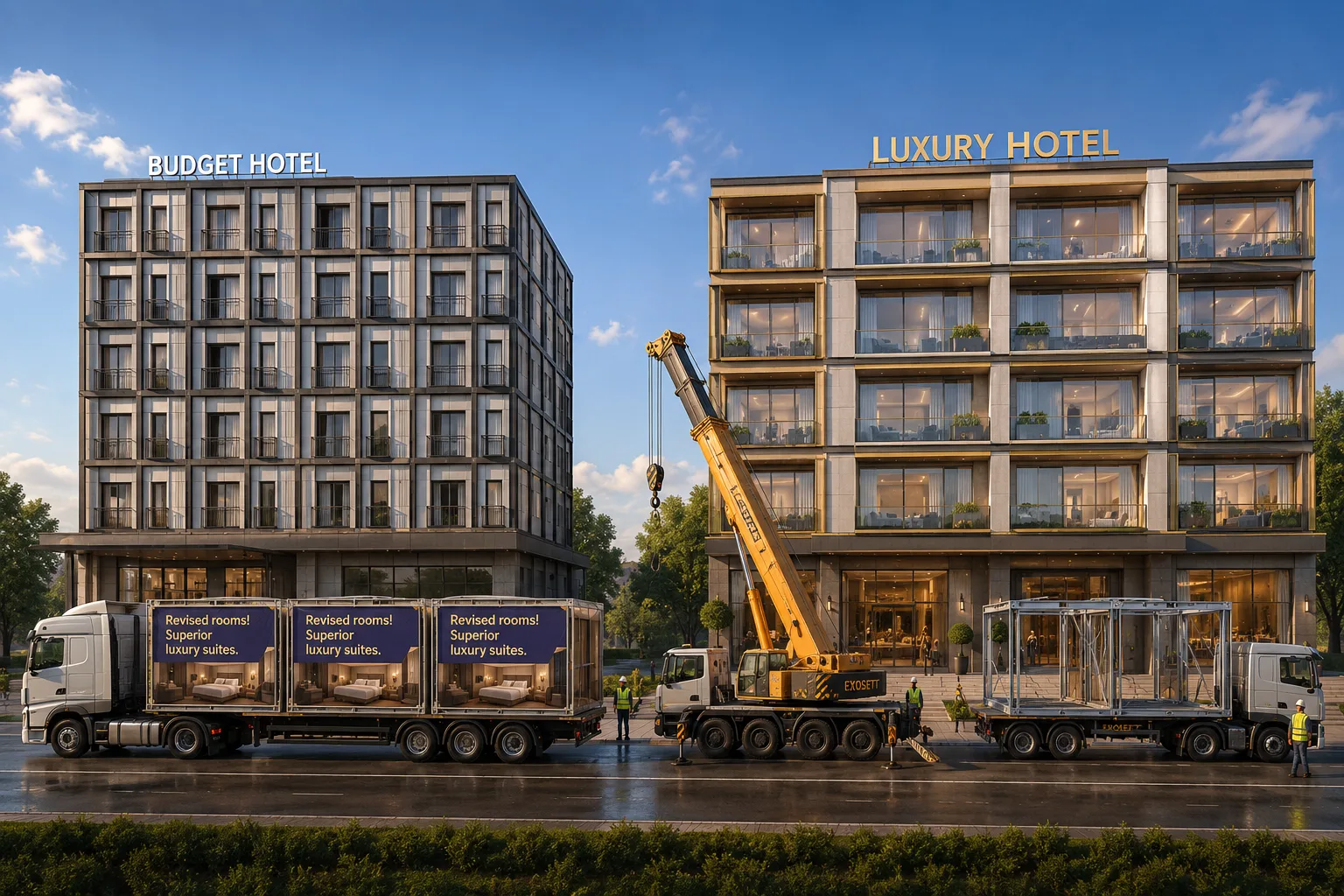
Hotels are among the clearest examples of where the flexibility offered by ExoSett can create significant long-term value.
Conventional hotels are typically designed and constructed for a fixed number and mix of rooms. Once built, the building changes little throughout its operational life. Major refurbishment programmes may require entire floors, or even the whole hotel, to close for extended periods while rooms are upgraded.
An ExoSett hotel can evolve continuously.
Individual room modules may be removed, refurbished, upgraded or replaced without affecting neighbouring rooms, allowing the hotel to remain in operation throughout the process. A damaged room could be exchanged quickly even when the hotel is otherwise full and guests remain in the rooms beside it.
The mix of accommodation can also change over time. Standard rooms may be replaced by larger suites. Additional accessible rooms may be introduced, or family accommodation created in response to changing demand. The accommodation frame can remain in use while the rooms it hosts evolve.
Hotel modules need not conform to ISO shipping-container dimensions or to a single standard size. A budget hotel chain may favour compact modules that maximise capacity, while a luxury brand may use much larger modules providing generous living space and premium facilities. The choice of module size reflects a balance between engineering constraints, operational efficiency, brand identity, guest expectations and financial considerations.
Many structural and operational components can remain common across very different hotel designs. Frame nodes, connection mechanisms, service interfaces, installation equipment and maintenance procedures may be shared between buildings hosting entirely different room modules. A hotel group could therefore benefit from a common engineering platform while preserving distinct brands and guest experiences.
ExoSett buildings can also operate with empty cells. Because the accommodation frame and its cells may be enclosed by a common external cladding system, the number of occupied rooms need not be apparent from outside. Capacity may therefore increase or decrease without changing the building’s outward appearance.
This flexibility is particularly valuable where demand varies sharply throughout the year. Ski resorts, coastal destinations and cities hosting major annual events such as the Calgary Stampede may experience enormous temporary increases in demand.
A hotel that ordinarily operates with 150 rooms might temporarily expand to 250 by adding further frame sections and room cassettes. When demand subsides, those additions could be removed, relocated or retained for use during future events.
Hotel groups could manage reusable frame components and accommodation cassettes across their entire estate. Cassettes removed from one hotel for refurbishment might be upgraded centrally and later installed at another location. Capacity, quality and room mix would become assets that could be managed strategically rather than characteristics fixed at construction.
In effect, ExoSett separates two decisions that conventional hotels combine into a single, largely irreversible investment. The accommodation frame, public spaces and utility infrastructure can be retained while useful. The room modules remain adaptable, replaceable and capable of evolving throughout the life of the hotel.
This story illustrates how an ExoSett system might be used. Actual implementations would require project-specific engineering, detailed design and any necessary regulatory approval.
What this story illustrates
This story illustrates how an adaptable ExoSett hotel could remain operational while its rooms are refurbished, replaced or reorganised.
It also shows how accommodation capacity, room mix and quality could be adjusted over time, both within an individual hotel and across a hotel group’s wider estate.