
ExoSett story
Flexible prison accommodation
A prison estate may need additional capacity quickly, then different accommodation or fewer places years later. ExoSett explores how adaptable modular prison accommodation could allow capacity to be added, replaced, reconfigured and eventually removed.
The prison has stood on this site for almost 70 years.
When it first opened, it contained 100 cells. Over the decades it expanded to accommodate as many as 250. Now only 30 remain in use, and soon there will be none.
Policy has changed. The earlier move towards smaller local prisons has been reversed in favour of larger centralised facilities. These are still ExoSett buildings, but on a much greater scale.
The oldest accommodation module configured as a prison cell remaining here is 15 years old. It is the prison’s last solitary-confinement cell. The requirements for these modules rarely change, and the cell itself is now seldom used.
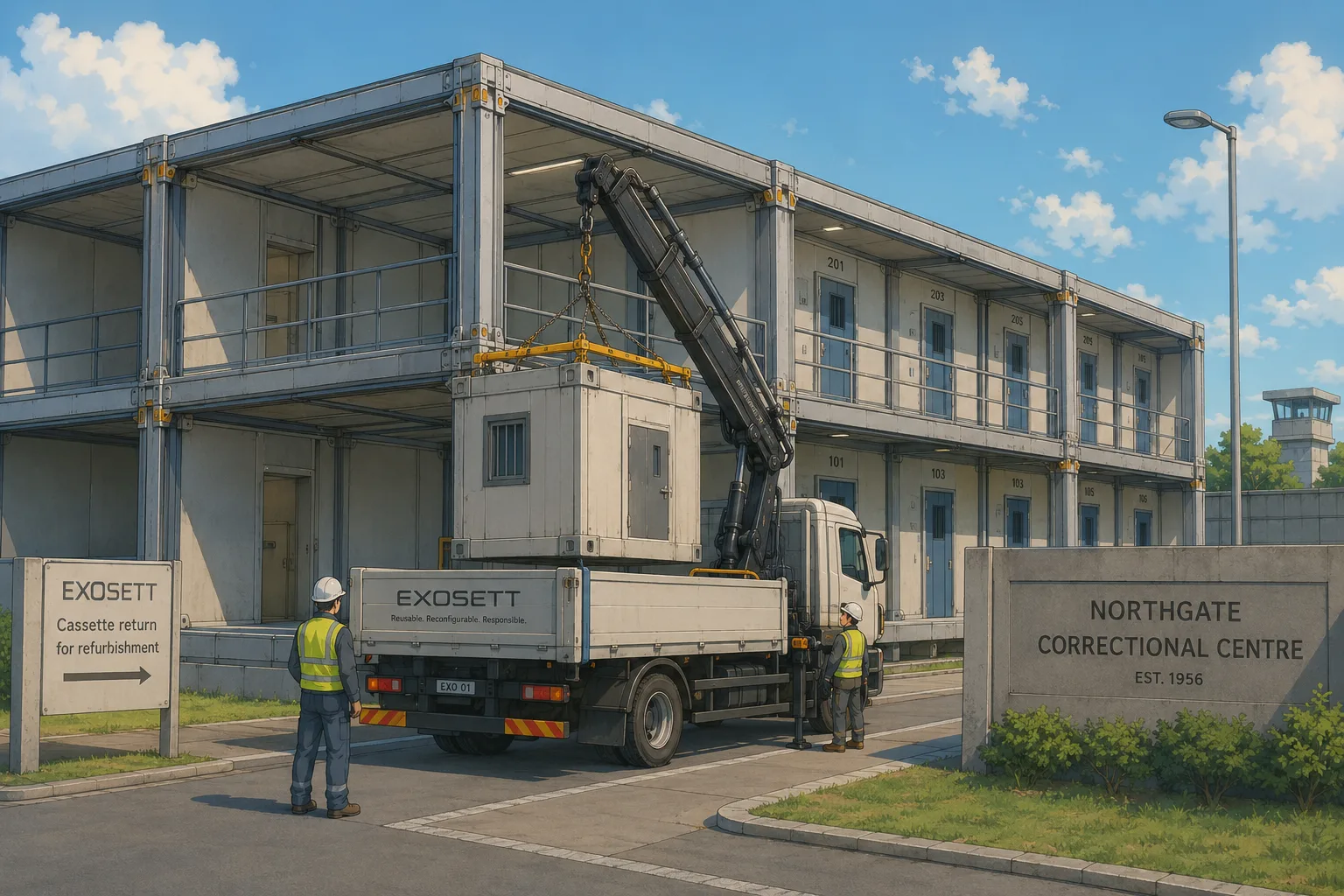
The newest cassette is only a few months old. It was installed as part of the prison’s normal programme of inspection, rotation and refurbishment. The cassette it replaced has already been returned to the factory, where it is being refurbished for use in another city.
As the prison population declined, the building contracted with it.
Accommodation cassettes were removed first. Later, as whole sections of the building became unnecessary, columns, beams and frame nodes were dismantled and taken elsewhere. Some now form part of local schools and hospitals. Others were sent overseas to provide emergency accommodation following the recent Pacific islands disaster.
There is no abandoned structure waiting to decay and no vast demolition project ahead.
Soon the last cassettes will leave. The remaining frame will be dismantled, its components inspected and returned to use elsewhere.
The prison will disappear.
In its place, there will be a park and a playground.
This story illustrates how an ExoSett system might be used. Actual implementations would require project-specific engineering, detailed design and any necessary regulatory approval.
What this story illustrates
Buildings can contract as well as expand. ExoSett buildings do not have to remain at their maximum size. Cassettes can be removed as demand falls, and the supporting frame can later be reduced when whole sections are no longer required.
Different parts of a building have different lifecycles. Accommodation cassettes, structural components and the site itself are not treated as one inseparable asset. A recently refurbished cassette can leave an old building and continue its working life elsewhere.
Structural components can be reused. Frame nodes, columns and beams are designed as recoverable building components rather than demolition waste. They can be inspected and incorporated into schools, hospitals, housing or other ExoSett buildings.
Buildings can adapt to changes in public policy. The prison expanded and contracted as penal policy and local demand changed. Its physical form was able to follow those changes rather than becoming prematurely obsolete.
Closure need not mean demolition. When the building is no longer required, it can be dismantled progressively. Valuable cassettes and structural elements remain in circulation, while the land can be returned to the community.
Value extends beyond the individual building. The prison itself is temporary, even after 70 years. The cassettes, frame components and land continue to have value beyond the life of this particular building.