
ExoSett story
Fire
How an ExoSett building could contain a localised fire, protect escape routes and recover by replacing a damaged cassette.
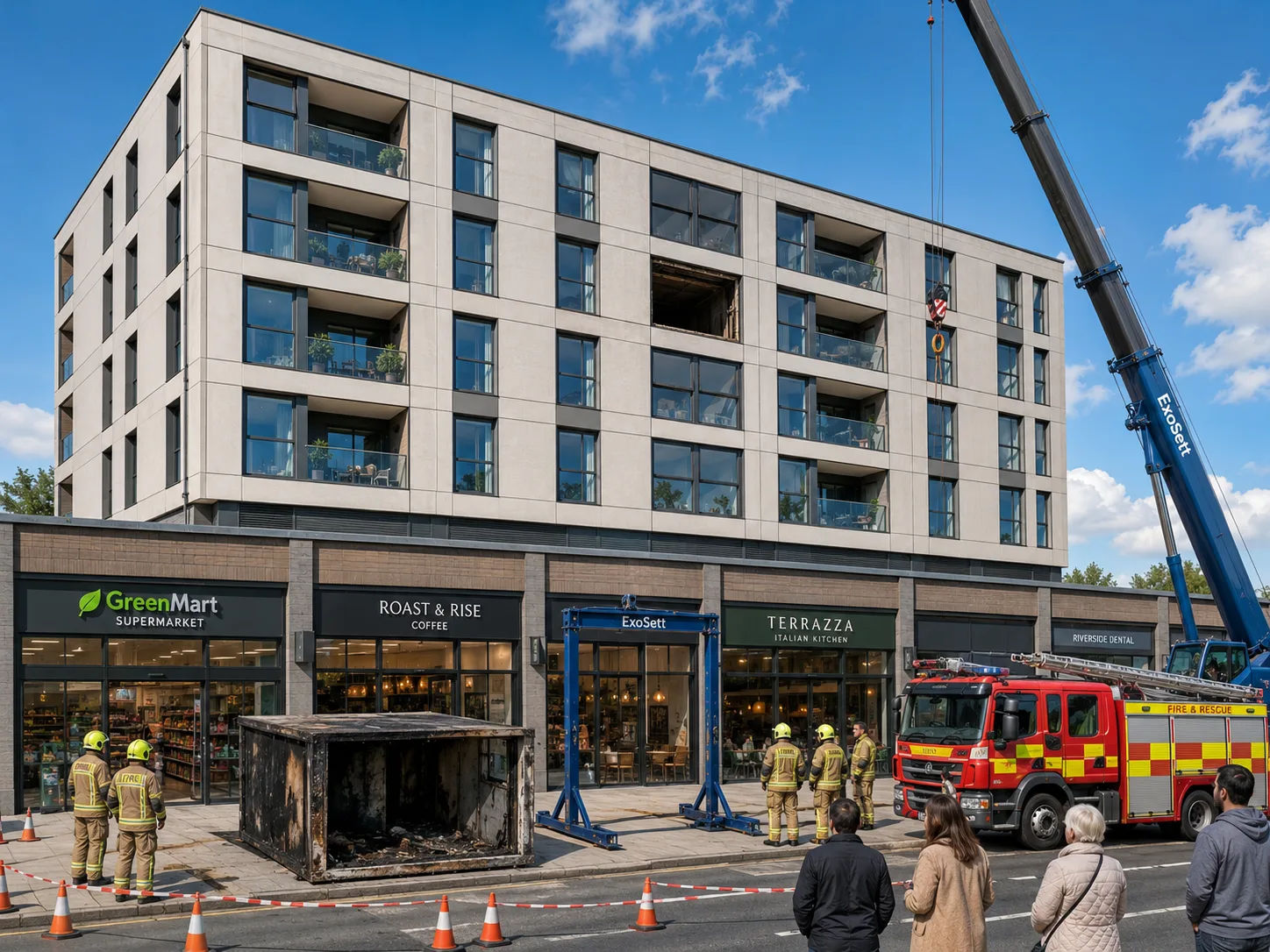
It started on an otherwise ordinary evening. I was at home when the building fire alarm sounded. There was no smoke in our flat, but the alarm was unmistakable. We put on shoes and coats, left immediately and followed the route through the service frame to the nearest stair.
By the time we reached the assembly point, smoke was visible near a flat several doors away. The fire service arrived soon afterwards and entered the building.
We later learned that an electrical fault in a kitchen appliance had started a fire inside one accommodation module. The occupants had been in another room when the smoke detector activated. They left safely, and nobody was injured.
In the car park, the fire service told us that the fire was out and appeared not to have spread beyond the dwelling where it began. We still had to wait while they completed their work and the building team assessed the affected area.
The fire-safety measures designed for this particular building had resisted the spread of fire beyond the affected dwelling. There was smoke contamination in the shared circulation spaces, so they needed to be ventilated and cleaned.
Specialists inspected the damaged cassette, the accommodation frame around it and the neighbouring accommodation. Once the unaffected parts of the building had been professionally assessed and declared safe, most of us were allowed home. The residents of the damaged flat were temporarily housed elsewhere.
After the investigation and inspections were complete, the damaged cassette was disconnected from the building services and removed from its cell. The accommodation frame was checked again before a replacement cassette was installed and connected. Most residents were able to remain in the building while this later work took place.
The fire was serious. ExoSett did not prevent it from happening, and it did not make the building fireproof.
What mattered in this case was that the building had been designed to detect the fire, support evacuation and resist its spread. That made it possible to assess the damage and replace the accommodation that could no longer be used.
This story illustrates how an ExoSett system might be used. Actual implementations would require project-specific engineering, detailed design and any necessary regulatory approval.
What this story illustrates
Fire safety in an ExoSett building must be addressed both within the accommodation modules and across the building as a complete system.
Accommodation modules and the assemblies between them can be designed and certified to meet the fire-safety requirements for a particular building. Specifications may address fire resistance, internal finishes, cavity barriers, penetrations, smoke detection, alarms and fire-suppression systems where required by the fire strategy or regulations, or otherwise selected for the project.
At the system level, the relationships between modules, cells, facades and service connections must be designed to resist the spread of fire and smoke. Escape routes through the service frame require suitable capacity, separation and protection. Access and facilities for the fire service must also be incorporated into the site and building design.
Because the accommodation frame is structurally independent of the modules , damage to one module does not automatically require the removal of neighbouring modules or the loss of the whole frame. It does not establish that the structure is safe after a fire. The frame, connections, adjacent accommodation, services and enclosure would require appropriate inspection and assessment.
A damaged cassette might be removable and replaceable once the incident has been investigated, services have been safely isolated, the remaining structure has been assessed and any necessary temporary protection and regulatory approvals are in place. Continued occupation of unaffected accommodation would depend on professional assessment of this particular building.
Together, these features may support an approach in which a localised incident can be contained and the building recovered without widespread demolition or long-term closure. Such outcomes are not automatic properties of every ExoSett building: the fire strategy, module ratings, suppression provision, escape design, inspection regime and approvals would depend on the building’s use, height and location, and on the applicable regulations.