
ExoSett story
Retirement living that evolves
People’s needs can change significantly during later life, but the buildings they live in are usually much less adaptable. ExoSett explores how retirement accommodation could change over time, allowing homes, shared spaces and support facilities to be added, replaced or reconfigured as residents’ needs and the community itself evolve.
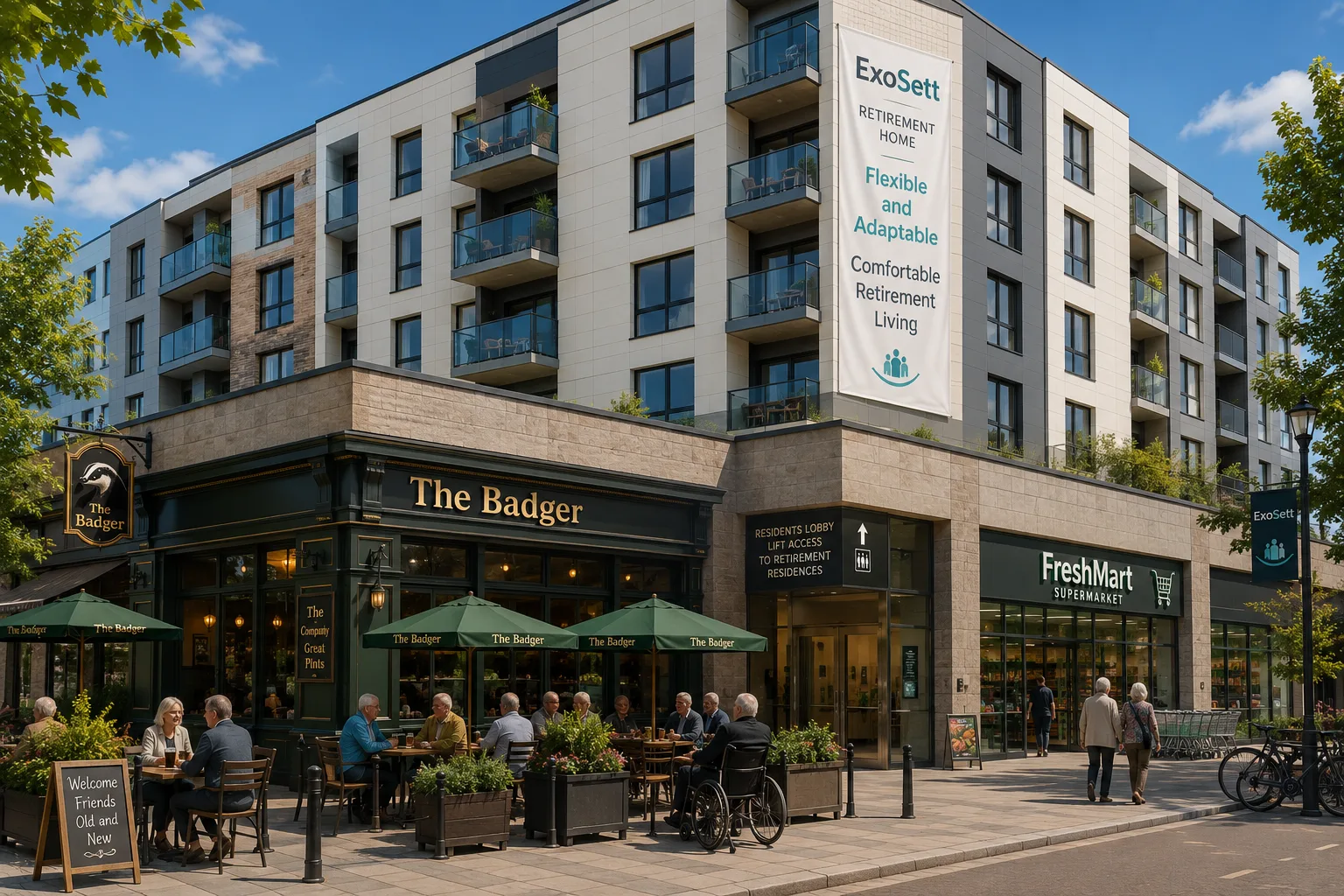
The pub is in the podium beneath the ExoSett building that has been my home for the last 23 years.
My wife and I moved here into a four-module apartment with plenty of living space, a guest bedroom and parking for the car. The guest room was supposedly for visitors, although in practice it was mostly for the children.
We quickly made friends with our new neighbours. Many of those friendships have lasted throughout our time here.
One of our friends is now in his mid-nineties. When we first moved in, he and his wife occupied an apartment much like ours.
In later years she developed dementia. As her needs changed, their home changed with them. Rooms were rearranged to make everyday life simpler and safer, while allowing them to continue living together in the home they knew.
Outside their apartment was the large green atrium at the heart of the retirement residence. Its gardens and looping walkways gave her somewhere safe and familiar to wander, with benches along the way and small places to stop: a café, quiet sitting rooms and other shared spaces. She could continue to move around a neighbourhood she recognised without her husband having to accompany her every moment.
As her illness progressed, more support could be brought to them rather than requiring them to move somewhere unfamiliar. They were able to remain together until she died.
Afterwards, as his own needs changed, their home changed again. His apartment was reduced to two modules. One now provides a spacious bedroom arranged around his care and mobility needs. The other contains a large accessible wet room.
Losing his wife was dreadful, and changing the home they had shared could not make that easier. But the building was able to evolve around both of them at different stages of their lives. He remained among his friends and familiar surroundings, and he can still come down to the pub in his wheelchair.
That is another benefit of living here. A lift runs directly from the retirement residence into a lobby within the podium. Off the lobby are the supermarket and the pub.
The pub entrance leads first into a small side bar, connected to the larger open bar beyond. We oldies can reserve the smaller room for quieter gatherings.
Best of all, my wife lets me come down here by myself.
Sometimes.
This story illustrates how an ExoSett system might be used. Actual implementations would require project-specific engineering, detailed design and any necessary regulatory approval.
What this story illustrates
An ExoSett retirement residence can provide generous homes for active and independent residents while allowing both individual homes and the shared environment to adapt as circumstances and care needs change, including when a resident develops dementia.
Living space, guest accommodation and other facilities can be reduced or rearranged as care and accessibility needs increase. Within a general retirement community, this adaptability can help residents preserve relationships, familiarity and independence. They can remain at the same address, close to established friends, familiar amenities and the wider community, rather than being forced to move simply because their dwelling no longer suits them.
Related stories: Downsizing and Simple utilities.