
ExoSett story
Emergency buildings that evolve
An emergency response may need to begin before anyone knows exactly what will be required. ExoSett explores how adaptable emergency accommodation could start small, expand quickly and change its mix of sleeping, medical, administrative and support spaces as needs evolve.
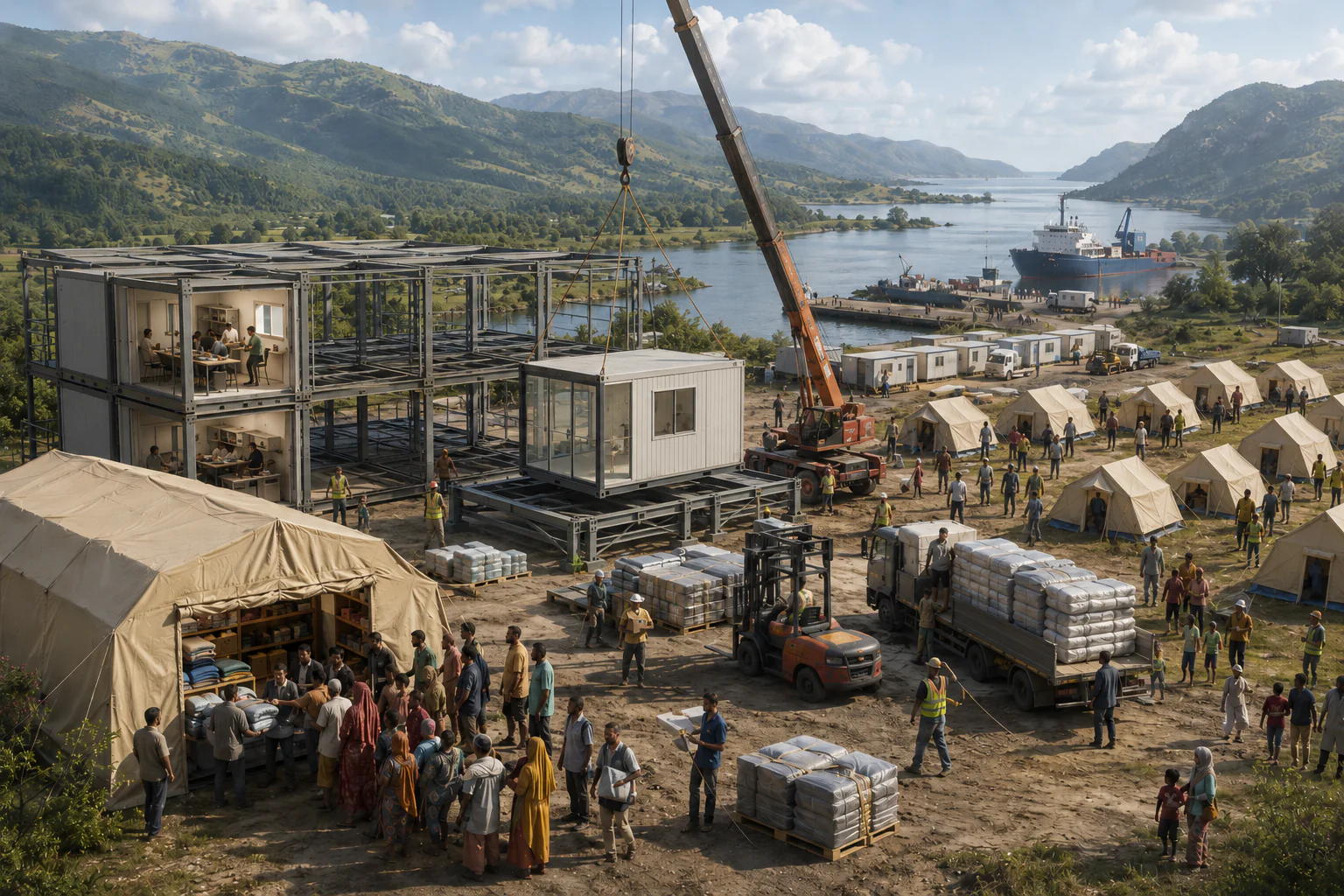
Four newly completed cells are available in the accommodation frame.
Down at the temporary dock there are five clinic cassettes waiting to come ashore, two kitchen cassettes, and a tent workshop cassette that arrived less than an hour ago.
The incident director has asked me to give priority to the clinics.
Normally, that would settle it.
My job is to coordinate the installation of cassettes into the ExoSett frames. I decide which cassettes move up from the dock, the order in which they are lifted into their target cells, and when the connection crews can make them ready for use.
The plan changes constantly.
The emergency centre stands in a wide, flat-bottomed valley beside a river that runs down to the sea. The accommodation frames are still being extended, but the first administration office, kitchen and clinic modules are already installed and operating.
The sequence depends partly on what the incident director wants, partly on which sections of frame the construction crew has completed, and partly on what has actually arrived at the dock.
This morning, the clinics were the clear priority.
Since then, several hundred displaced people have reached the site. Most are not injured. They need shelter, bedding and somewhere safe for their children to sleep.
So I use one of the four available cells for the tent workshop.
The name is slightly misleading. Once installed, it provides a proper workspace where shelter teams can issue equipment, inspect damaged tents and prepare returned stock for reuse. But each workshop cassette also arrives packed with hundreds of compact high-performance emergency tents, along with bedding, tools and repair materials.
We only need one workshop operating at a time. As its stock is used, a newly supplied workshop cassette can replace it and the depleted cassette can be sent away to be cleaned, repaired and replenished.
Within minutes of the cassette being connected, the shelter team opens the doors.
Word spreads quickly. A queue forms outside as families collect tents and bedding. Soon afterwards, a new neighbourhood begins to appear across the field.
The remaining three cells receive clinic modules.
More will follow as soon as the frame crew releases the next section of cells.
There are still kitchen cassettes waiting at the dock, and an operating theatre has just arrived aboard RFA Wessex Bay, one of several humanitarian aid and disaster relief vessels ferrying equipment into the area.
By tomorrow morning, the priorities may have changed again.
It is managed chaos.
In a few weeks, when the immediate pressure has passed, we will probably move many of the cassettes into a more sensible arrangement. For now, each completed cell gives us somewhere to put whatever the emergency needs next.
This story illustrates how an ExoSett system might be used. Actual implementations would require project-specific engineering, detailed design and any necessary regulatory approval.
What this story illustrates
An ExoSett emergency centre can begin operating before every part of the building is complete. Each finished cell creates capacity for the cassette that is most urgently needed at that moment.
Standardised accommodation modules can be installed, replaced and rearranged as operational priorities change. An installation frame supports their controlled movement into and out of the building.
Separating the accommodation frame from the modules allows construction and occupation to progress together, while retaining the ability to create a more settled arrangement later.